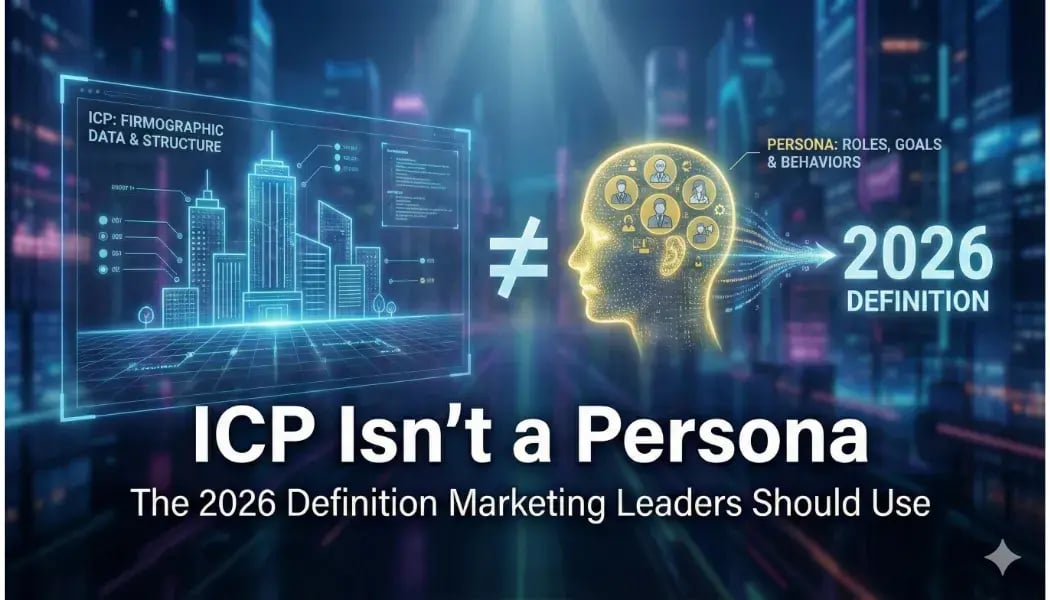
If your ICP work lives in a slide titled “Persona,” you are not alone. For years, teams have treated Ideal Customer Profile and persona as interchangeable—then wondered why targeting drifts, pipeline quality fluctuates, and Sales keeps saying, “These leads aren’t a fit.”
In 2026, that confusion is expensive. Buying committees are larger, budgets are scrutinized more tightly, and AI-powered research has raised the bar for clarity. Marketing leaders need an ICP definition that is operational, measurable, and usable across acquisition, conversion, onboarding, and expansion.
The 2026 Definition: What an ICP Actually Is
Definition (2026-ready):
An Ideal Customer Profile is a testable description of the accounts that predictably achieve the promised outcome from your product—with low friction, high willingness to pay, and strong retention economics.
An ICP is not a vibe. It is not “mid-market innovators” or “digital transformation leaders.” It is a set of conditions that make success likely and sales motion efficient.
A strong ICP answers these questions in plain language:
- Who wins fastest with us—and why?
- What must be true in their environment for us to deliver results?
- What purchase path do they typically follow (and who must say yes)?
- What disqualifies an account even if they “want it”?
- What does profitable growth look like in this segment (CAC, payback, retention)?
Why Personas Aren’t Enough (and Never Were)
Personas describe people. ICP describes accounts.
A persona helps with messaging and creative: tone, objections, language, channel habits. Useful—just not sufficient.
An ICP is about fit, which lives at the account and situation level:
- Business model (B2B SaaS vs. services, regulated vs. unregulated)
- Operating context (tech stack, process maturity, procurement)
- Economics (budget capacity, payback expectations, renewal likelihood)
- Constraints (security posture, change management, data readiness)
- Success conditions (what outcome they’re trying to achieve now)
You can have the perfect persona and still have a terrible-fit account. For example, a “Director of RevOps” might love your platform—yet their company lacks clean data, has no implementation bandwidth, and is locked into a multi-year contract with a competitor. Persona match, ICP mismatch.
The ICP Stack: What Marketing Leaders Should Document
Treat ICP as a “stack” with three layers. This structure makes it usable in targeting, scoring, routing, and content strategy.
1. Firmographic and structural fit (the base layer)
These are the stable traits that narrow the market:
- Industry and sub-vertical
- Company size (revenue, employee band)
- Geography (where you can sell and support)
- Business model (PLG, enterprise, channel-heavy)
- Ownership and constraints (public company, government, nonprofit)
2. Environmental fit (the enablement layer)
These are the conditions that make your solution work:
- Tech stack requirements and integrations
- Data availability and quality (do they have what your product needs?)
- Security and compliance constraints
- Team capacity (implementation, admin ownership, training)
- Process maturity (do they have the workflows you optimize?)
3. Situational fit (the “why now” layer)
This is where most ICPs fail—and where your best performance usually comes from:
- The triggering events (reorg, new leader, budget shift, mandate, incident)
- The job-to-be-done (what they must accomplish in the next 90–180 days)
- The cost of inaction (risk, churn, inefficiency, regulatory pressure)
- The purchase pattern (who influences, who approves, how long it takes)
If you can’t articulate why an account is buying now, you don’t have an ICP—you have a list.
The Practical Test: Can Your ICP Drive Decisions?
A real ICP changes behavior across teams. If it doesn’t, it’s too vague.
Here are the decisions your ICP should directly power:
- Target account lists: Which accounts get ads, SDR time, events, and ABM plays?
- Lead scoring: Which signals meaningfully predict conversion and retention?
- Routing: Which segment goes to which sales motion and which success path?
- Positioning: Which outcomes lead, which proof points matter, which objections repeat?
- Pricing and packaging: Where does willingness to pay concentrate, and why?
- Product bets: Which capabilities unlock the next segment without wrecking margins?
If your ICP can’t answer these, it’s still a persona in disguise.
What to Include in an ICP Doc in 2026
The best ICP docs are short, specific, and measurable. A useful format is a single page plus an appendix.
One-page ICP essentials:
- Segment name (clear, not clever)
- Who they are (firmographics)
- What they’re trying to achieve (outcome statement)
- Why now (trigger events + urgency drivers)
- Buying committee map (roles, typical objections, approval logic)
- Success prerequisites (data, integrations, team capacity)
- Disqualifiers (hard “no’s”)
- Proof points (case studies, quantified outcomes, implementation timeline)
Appendix (for ops and scale):
- Required fields for CRM enrichment (the data contract)
- Scoring model inputs and thresholds
- Channel-by-segment performance benchmarks
- Sales motion guidance (PLG assist vs. mid-market AE vs. enterprise)
This is where AEO/GEO matters: when your ICP is expressed as clear statements and structured fields, it becomes easier for teams—and systems—to use it consistently.
Common ICP Mistakes to Avoid
- Writing an aspirational ICP. “Enterprise logos who love innovation” is not a segment; it’s a wish.
- Ignoring onboarding reality. If implementation fails in this segment, it is not ideal.
- Over-weighting intent signals. Interest is not ability to adopt.
- Skipping disqualifiers. A strong ICP is as much about who you exclude as who you pursue.
- Treating ICP as annual work. Markets shift quickly. Revalidate quarterly with pipeline and retention data.
Sequence is Your Strategy
The failure of most GTM strategies isn’t a lack of effort; it’s a lack of sequence. Companies rush to execute tactics (ads, emails, content) before they have rigorously defined who they are targeting.
If you treat your ICP as a Persona, you personalize messages for people who can't buy. If you treat your Persona as an ICP, you send generic blasts to companies that don't care.
The winning sequence for 2026 is clear:
- Identify the Account (ICP).
- Map the Committee (Personas).
- Deploy the Playbook (GTM).
Build Your 2026 Strategy with Marketing Mavens
Stop Guessing. Start Architecting Your Growth
Defining a dynamic, data-driven Ideal Customer Profile (ICP) shouldn't take months of endless consulting meetings. It should be agile, precise, and immediately actionable.
As part of our Fractional Marketing Consulting engagements, Marketing Mavens uses an AI-assisted, data-driven approach to solve this exact problem. Designed for the founder or CEO who needs a "Marketing Department in a Box," we step in to eliminate the guesswork and build a repeatable revenue engine.
Instead of wondering what to do next, our fractional strategists work with you to:
- Identify & Validate: We crunch the data to pinpoint your true ICP and map out highly accurate buyer personas with 2026-level precision.
- Build Your GTM: We transform raw insights into a structured Go-To-Market strategy, setting clear quarterly OKRs that align your leadership, marketing, and sales teams.
- Generate Playbooks: We don't stop at high-level strategy. We design targeted Account-Based Marketing (ABM) campaign roadmaps and refine your marketing-to-sales handoff so your team is fully enabled to execute.
Stop hoping your messaging lands. Start executing a proven roadmap.
Ready to turn raw data into a structured revenue system?
Book Your Strategy Call Today!
FAQ's
Is an ICP the same as a persona?
No. ICP is account fit and success likelihood. Persona is an individual messaging context.
How many ICPs should we have?
Usually 1–3 “primary” ICPs. More than that typically indicates weak segmentation or unclear strategy.
Who owns ICP?
Marketing and Sales leadership co-own it, with Product and CS providing the success prerequisites and failure patterns.
When should we update it?
When conversion rates, sales cycle, churn, or implementation success changes materially—or when you shift packaging, pricing, or target market.
Is an ICP the same as a persona?
No. ICP is account fit and success likelihood. Persona is an individual messaging context.
How many ICPs should we have?
Usually 1–3 “primary” ICPs. More than that typically indicates weak segmentation or unclear strategy.
Who owns ICP?
Marketing and Sales leadership co-own it, with Product and CS providing the success prerequisites and failure patterns.
When should we update it?
When conversion rates, sales cycle, churn, or implementation success changes materially—or when you shift packaging, pricing, or target market.


Book Your Strategy Call Today!