
Stop Fighting your Tools and Start Growing
Most Startups and SMEs under $25M do not have a Software Shortage. They have a Coordination Problem.
When marketing runs in one tool, sales in another, customer success somewhere else, and the website on a separate CMS, your growth engine stalls. Reporting breaks, handoffs slow down, and scaling becomes a manual, uphill battle.


The Real Problem is Disconnected Tools
For growing companies, the biggest drag on growth is rarely a lack of software—it’s the "integration tax" of running too many disconnected systems.
According to MarTech’s 2025 State of Your Stack Survey, 65.7% of organizations cite data integration as their top challenge. For companies under $25M, budget constraints make this friction even more painful. You don't have the luxury of a massive IT department to build custom bridges between tools; you need a system that works out of the box.
Why Disconnection Hurts Small Teams Most
Enterprise companies can absorb the overhead of vendor management and manual data entry. Smaller companies cannot. To scale, you need:
- Fewer handoffs: Leads shouldn't get lost between "Marketing" tools and "Sales" tools.
- Cleaner reporting: You need to see exactly which dollar of marketing spend led to which dollar of revenue.
- Faster execution: Your team should spend time closing deals, not exporting CSVs to "sync" platforms.

What One CRM Should Actually Unify
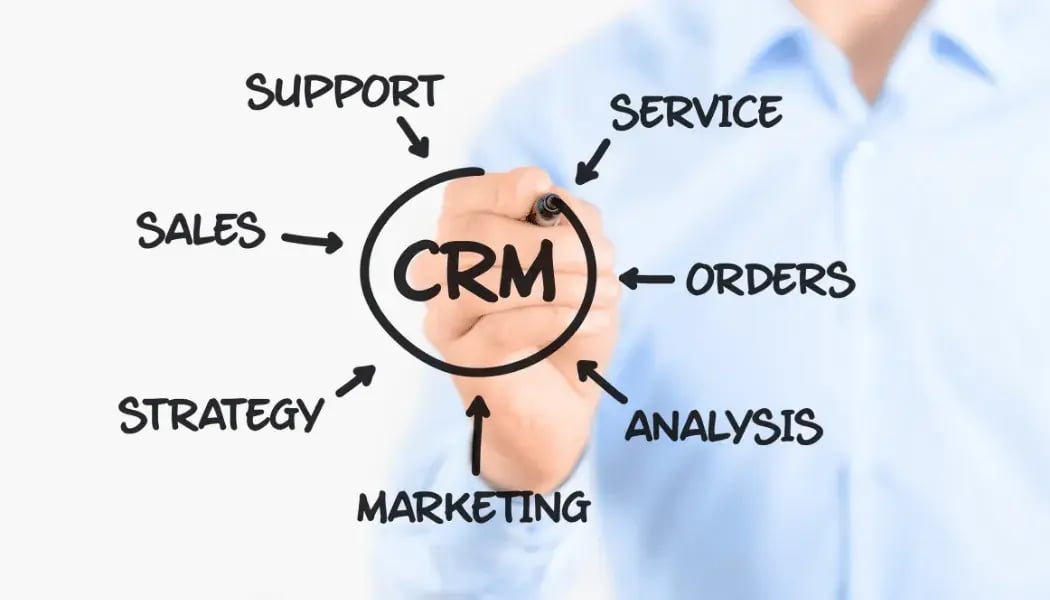
A CRM should be more than a digital Rolodex. For an early-stage or mid-market company, it must connect the entire customer journey:
- Marketing: Lead capture and automated nurture campaigns.
- Sales: Pipeline visibility and deal stages.
- Service: Seamless onboarding and customer support.
- Content: A website CMS that talks directly to your lead data.
- Data: Real-time lifecycle attribution and revenue reporting.
HubSpot is the market leader for this "all-in-one" approach, specifically designed to help founders and lean teams find and win customers without enterprise-level complexity.
Is your current stack holding you back?
Proven ROI of Consolidation
The data shows that consolidation isn't just about "tidying up"—it’s about revenue. HubSpot reports that after one year, customers see:
129% Increase in Lead Acquisition
36% More Closed Deals.
37% Improvement in Ticket Closure Rates.
Real-World Success Stories:
2030 Builders (1–25 employees): Reported 50% higher sales efficiency and 20% higher marketing efficiency, saving $50k/year in headcount costs.
IN-18: Centralized commercial workflows to increase sales attribution by 70% while eliminating five separate payment platforms.
YuLife: Scaled from 40 to 1,200+ organizations by using HubSpot as the single source of truth across the entire lifecycle.

The "Consolidation Checklist"
When should a startup move to one platform? If you recognize these symptoms, you have outgrown your "point solution" stack:
- Marketing and Sales reports never match.
- Customer data lives in scattered spreadsheets and Slack threads.
- Your website is a "black box" disconnected from your CRM.
- Success teams have no visibility into what Sales promised the customer.
- Leadership doesn't trust the revenue funnel reporting.
Don't wait for your system to break.
FAQ's
What is the best CRM for SMEs under $25M?
HubSpot is consistently the top choice because it bundles marketing, sales, service, and CMS into one "Smart CRM," specifically designed to scale with startups.
Why is a fragmented tech stack bad for growth?
Fragmented stacks create "data silos." When information doesn't flow, your team works slower, leads get ignored, and your CAC (Customer Acquisition Cost) skyrockets due to inefficiency.
Does HubSpot include a website CMS?
Yes. HubSpot’s Content Hub allows you to build your website directly on top of your CRM data, allowing for advanced personalization and perfect attribution.
Ready to Build a Growth System that Actually Scales?
If your team is outgrowing spreadsheets, disconnected tools, and unreliable reporting, the next step is not more apps. It is a more connected operating model.